


Less is More: Refactoring the CAR Signaling Domain
What will drug discovery look like when intelligence is abundant? Our small team is an experiment that began with this question. Eight months in, we’re excited to share some first results and the story behind them.
In vivo CAR T & signaling domain compression
Chimeric antigen receptors (CARs) reprogram the immune system to kill cancer cells. Expressed on the surface of T-cells, CARs connect an extracellular binder that targets a tumor antigen to an intracellular signaling domain that triggers the T-cell’s response. Much of CAR engineering focuses on the binder, while signaling domains largely follow a few established designs.
CAR T therapy traditionally involves collecting a patient’s T-cells, engineering them outside the body, and infusing them back. In vivo CAR T simplifies this process by delivering genetic instructions directly into T-cells inside the body. Payload size matters in this setting. With mRNA delivery, a smaller payload means more molecules at the same mass dose. 1 So we asked: Can we design a smaller signaling domain that preserves function?
1
mRNA encodes instructions for T-cells to produce CARs and display them on their surface. Introducing mRNA into cells is called transfection. An alternative is to integrate DNA encoding the CAR into the cells’ genome. We use mRNA transfection throughout our experiments.
For comparison, we used a second-generation CAR whose signaling domain combines 4-1BB costimulation with CD3ζ activation. We call this architecture BBζ.
In just a few months, the team developed a refactored 2 signaling domain that did more with less: one-third the length of BBζ, with improved CAR expression and T-cell function.
2
In software, refactoring changes how code is organized while preserving its function. Here, we apply the idea to CAR signaling domains.
Rational design at scale
Using Claude Code, we built an agent harness that orchestrates LLM reasoning and computational tools with a focus on structured outputs and observability. Scientists could steer and critique the exploration, inspect the evidence behind each design, and compare candidate sequences and their rationale.
We drove the system toward a bold question: What if we rethought signaling domains from the ground up?
Each design represented a hypothesis about how signaling function might be preserved in a smaller construct, complete with supporting evidence, reasoning, and assumptions. Through iterations of review and steering, we selected 186 designs for the initial round of testing.
In many ways, this process resembled traditional rational design before the advent of ML methods, where experts, guided by hypotheses, manually inspected sequences and introduced intentional edits. The problem with that approach was scale, which we can now solve with agents.
Mapping the space of signaling domains
We tested the initial designs in Jurkat cells, measuring NFAT activation and tonic activation 3 . To our surprise, dozens of refactored designs produced higher on-target activation than BBζ, with lower tonic activation.
3
Jurkat cells are a human T-cell line used to screen signaling. NFAT activity is a readout of T-cell activation. Tonic activation is signaling in the absence of the target antigen.
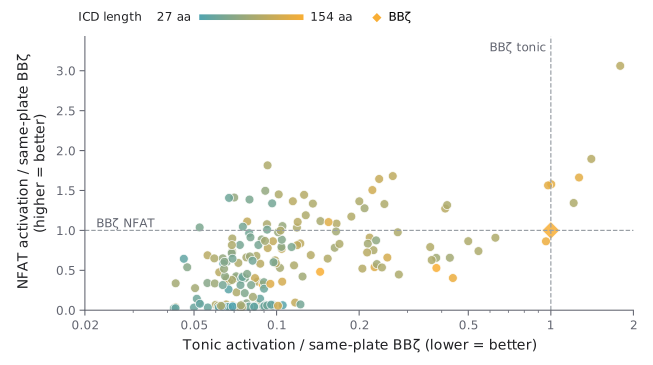
BBζ (dashed lines). Colors denote construct length. Many short designs produced high on-target activation and low tonic activation. Target: BCMA; binder: ddBCMA D-domain.We selected the top designs for testing in donor-derived primary T-cells. Across a range of effector-to-target (E:T) ratios (the number of T-cells per target cell), we measured IFN-γ secretion and killing 4 of BCMA-positive myeloma cells. Several refactored designs performed comparably to BBζ.
4
IFN-γ (interferon gamma) is a cytokine measured as a readout of T-cell activation. Killing is measured through residual luminescence: a light signal from surviving target cells, with less light indicating more killing.
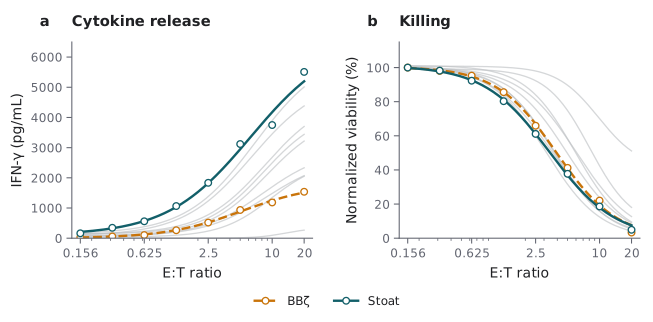
BBζ. First: IFN-γ secretion against BCMA-positive K562 cells. Second: normalized viability of H929 myeloma cells after co-culture (lower = more killing). Viability is normalized to the lowest E:T ratio for each replicate. Target: BCMA; binder: bb2121 scFv.In particular, a design executed by Opus 4.6 released more IFN-γ than BBζ while matching its killing at just 54 amino acids, one-third the length of BBζ. We nicknamed this design Stoat.

Stoat
A small, short-tailed weasel known for taking on much larger prey.
Stoat showed a glimpse of the richness of this vast yet under-explored sequence space. Following its lead, we worked with Claude Code through two more rounds of design and screening, exploring new sequences that probe, extend, and combine validated ideas. Among them was an even more potent variant of Stoat, at just 45 amino acids, which we named Happy Stoat.
Happy Stoat shows that smaller can be better
With deeper characterization, we started to understand surface expression as a key advantage of Happy Stoat. At the same mRNA dose, Happy Stoat expresses more CARs on the T-cell’s surface than both BBζ and Stoat.
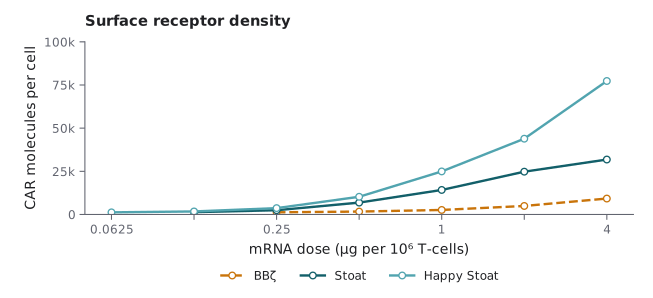
BBζ across the measured doses, with Stoat in between. Target: BCMA; binder: bb2121 scFv.This leads to stronger cytokine release across mRNA doses and E:T ratios.
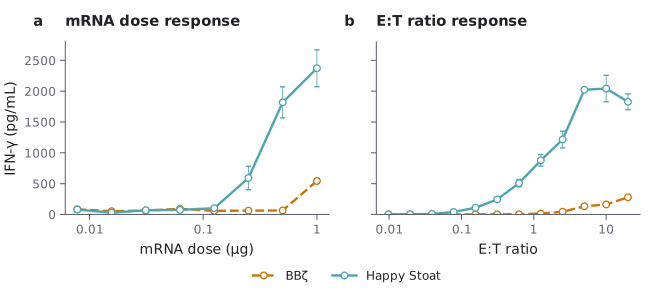
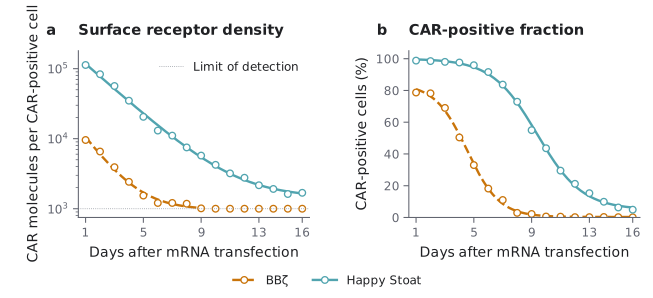
In a time-course experiment, Happy Stoat maintained high expression for much longer than BBζ, reaching similar expression levels after one week compared to BBζ on the first day.
This persistence advantage transfers to killing. Happy Stoat kills at lower E:T ratios than BBζ, with the gap accentuated a few days after transfection.
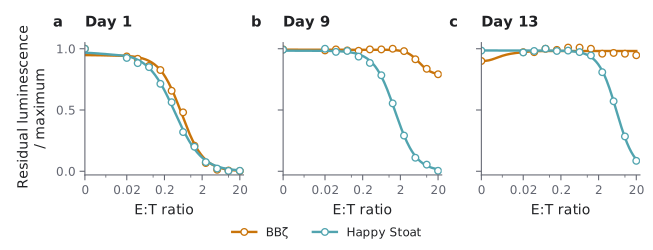
BBζ over time after mRNA transfection. Residual luminescence, normalized to the maximum for each construct and day, is shown across E:T ratios; lower values indicate more killing. Target: BCMA; binder: bb2121 scFv.Toward in vivo delivery
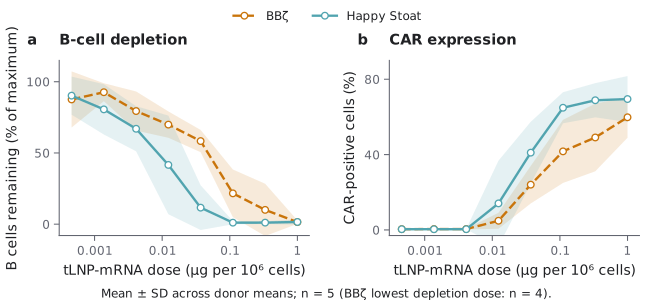
Next, we tested Happy Stoat in an end-to-end system that models delivery and activity for in vivo CAR T. We delivered Happy Stoat as mRNA in targeted lipid nanoparticles (tLNPs). We added tLNPs carrying mRNA encoding CD19-targeting CARs directly to whole peripheral blood mononuclear cell (PBMC) cultures 5 , with the donor’s own B cells serving as targets. One day later, we measured CAR expression and B-cell depletion.
5
tLNPs are lipid particles designed to deliver mRNA to particular cell types. PBMCs are a mixture of immune cells isolated from blood, including T-cells and B cells.
Across five donors, Happy Stoat achieved comparable B-cell depletion at lower mRNA doses than BBζ.
We continue to validate and optimize these refactored CAR signaling domains and apply them to new medicines. Recently, we partnered with Anthropic to extend our agentic methods to target selection and validation. Combining our technologies and teams, we are using Claude to identify promising antigen combinations for early-stage solid tumors, and we expect experimental results from this work within the next six months. To learn more about this collaboration, check out the announcement from Anthropic.
The team behind the science
Happy Stoat is a story of simplification. Successive generations of CARs added signaling domain components to amplify function. We set out to do the opposite – and found, to our surprise, that a smaller and simpler design can actually do more.
The same idea shaped the Canelé team. As intelligence becomes abundant, we believe a small team of high-agency scientists can accomplish what was once unimaginable. We have no meetings and no management layers, and we started with no software.

Canelé
We named the team after the Bordeaux pastry: simple ingredients, notoriously demanding execution.
We built our own electronic lab notebook, which grew to house all our sequences, protocols, and experimental data. Most of the code was written with Claude Code by wet-lab scientists who had never programmed before.
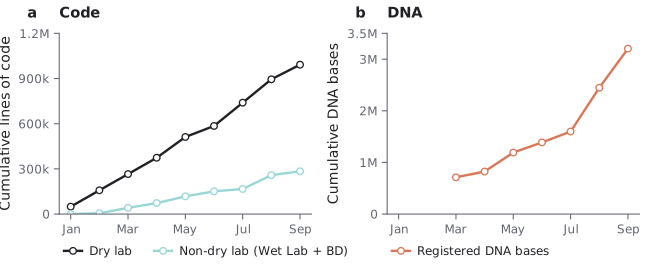
Agents dissolve the barriers of expertise. The CAR biologist built software, the software engineer designed CAR constructs, and the business strategist analyzed experiment data. Instead of handoffs, it felt like we were all building together.
Looking back, reinvention was the constant. Our tools evolved alongside our understanding in a process of creative destruction. We un-shipped pieces of our software, especially UIs, when we found ourselves using Claude Code to directly interface with the underlying records. Time and again, we tore apart and rebuilt the agent stack that orchestrates our computational workflows, on which we’ll share more soon. This spirit of reinvention guides our approach to CAR signaling and the way we do science: constantly rethink from the ground up to be simpler and more effective.
To learn more about this work, check out our preprint.
If you’re interested in building with us, reach out at
[email protected].
Acknowledgements
Thanks to Liam Bai, Aakriti Kumar, Hetvi Desai, Jiahe Li, Wujie Wang and Jason Yi.